Home / Procurement Training / Inside a Public Tender
Course · PST-02 · Reviewed November 2026
Run a public tender before you have to run a real one.
A hands-on course for people from outside the public sector. You join a council as its new procurement officer and take a £1.8 million contract from "it's ending soon" to a signed contract under the Procurement Act 2023, making the calls yourself and living with the consequences.
- Free
- No sign-up
- 3 to 4 hours
- Certificate to share on LinkedIn
10 modules, 16 real decisions, hands-on scoring and calculations, a test at the end of every module, and a certificate to share on LinkedIn.
Just type your name and start. Your progress saves in your browser, so you can stop and come back.

Who it's for
Good buyers find public procurement strange. Here's why.
Public procurement isn't harder than private buying, but the rules exist for different reasons. Once you've run a tender yourself, even a fictional one, they stop being mysterious.
I've moved into a public sector job and everyone talks in notice numbers.
Private buyers going public. Learn the Act, the notices and the procedures by using them on a real-feeling contract.
We bid for council contracts and never know how they really score us.
Suppliers. Design the award criteria and score real tender answers yourself, and you'll write better bids.
Why can't the council just pick the supplier it trusts?
Anyone working alongside procurement. Budget holders, finance and project managers: see why the rules exist, and how to work with them.
The scenario
Kestrel Vale District Council needs a new grounds maintenance contract
Parks, cemeteries and verges, about £255,000 a year, run by the same contractor for six years. It's now your job to re-tender it, and everyone has an opinion.
Head of Procurement. Fair, calm, and keen that nothing ends up in court.
Parks Manager. Knows every park, likes the incumbent, and wants this done fast.
Wants local firms to win council work, and says so often.
The incumbent, a local SME and a national firm. Only one can win.
All fictional. The law, guidance, thresholds and notices are real.
Inside the course
You don't just read about tendering. You do it.
Short lessons, then you're straight into the work: decisions, calculations and scoring, with feedback at every step.
Make the calls, see the consequences
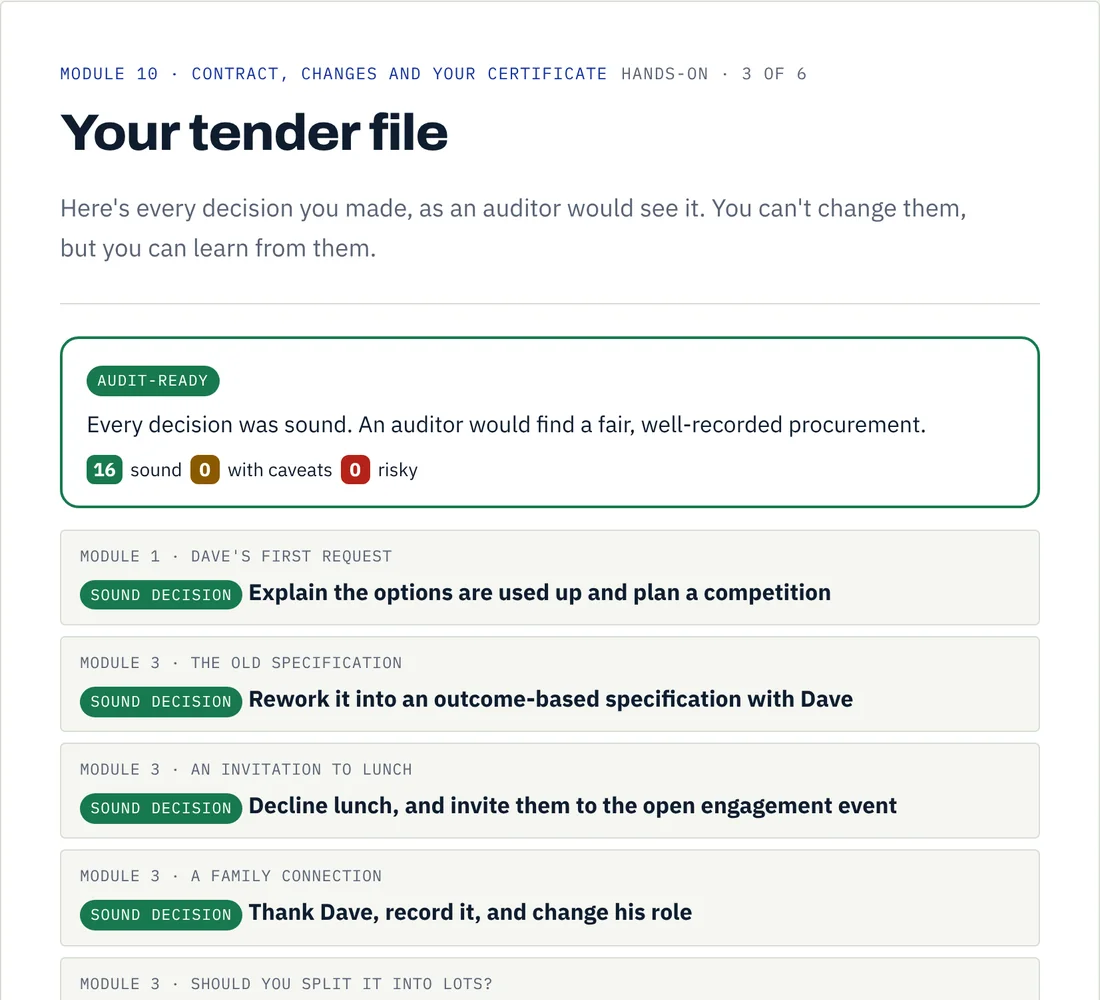
Extend the incumbent? Accept the lunch? Split into lots? Accept a late bid? Each choice is marked sound, defensible or risky, with an explanation and what an experienced public buyer would do. Your first choice is recorded, and at the end you see your whole tender file as an auditor would.
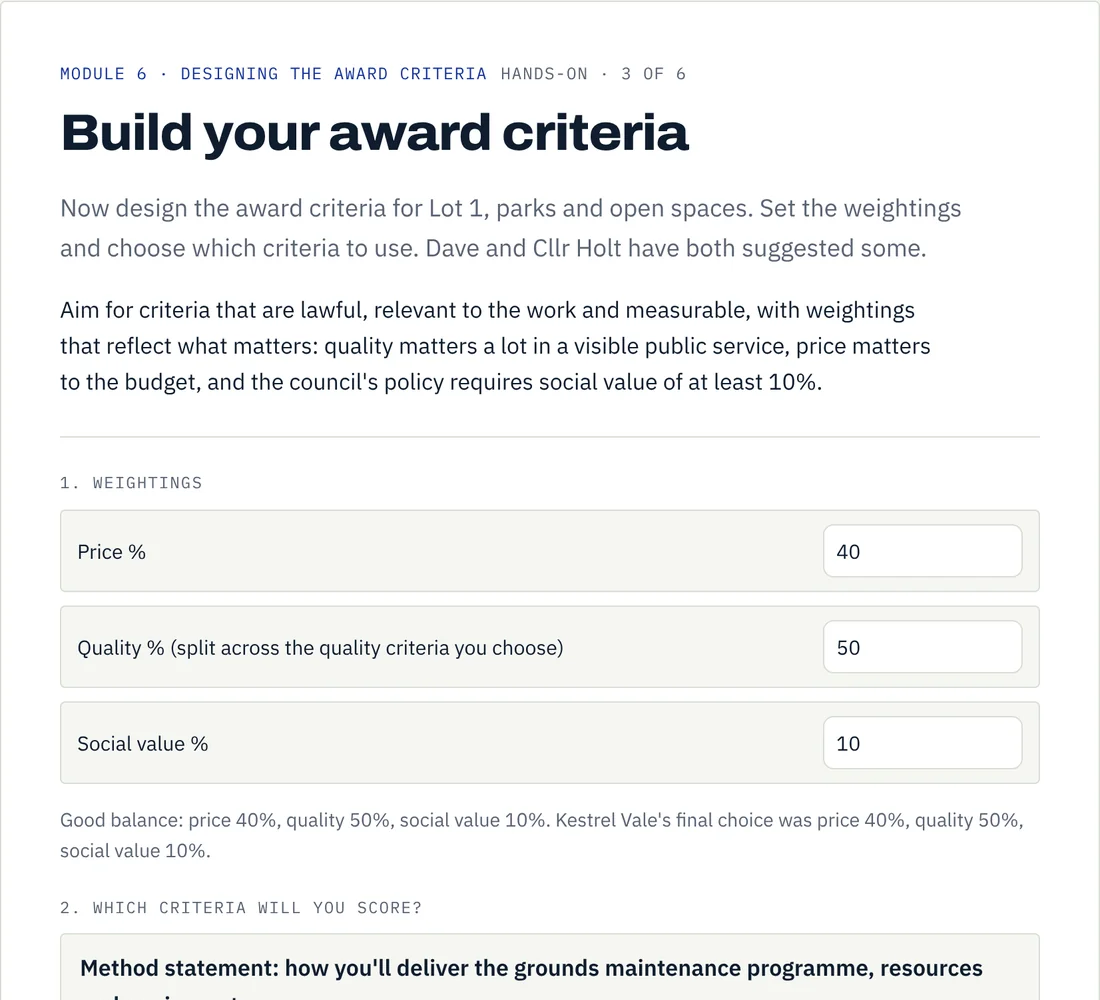
Design award criteria that would survive a challenge
Set the price, quality and social value weightings, then decide which of the suggested criteria are lawful. Some came from the budget holder and a councillor, and not all of them are allowed.
- Why "based in the district" is unlawful above threshold
- The difference between award criteria and conditions of participation
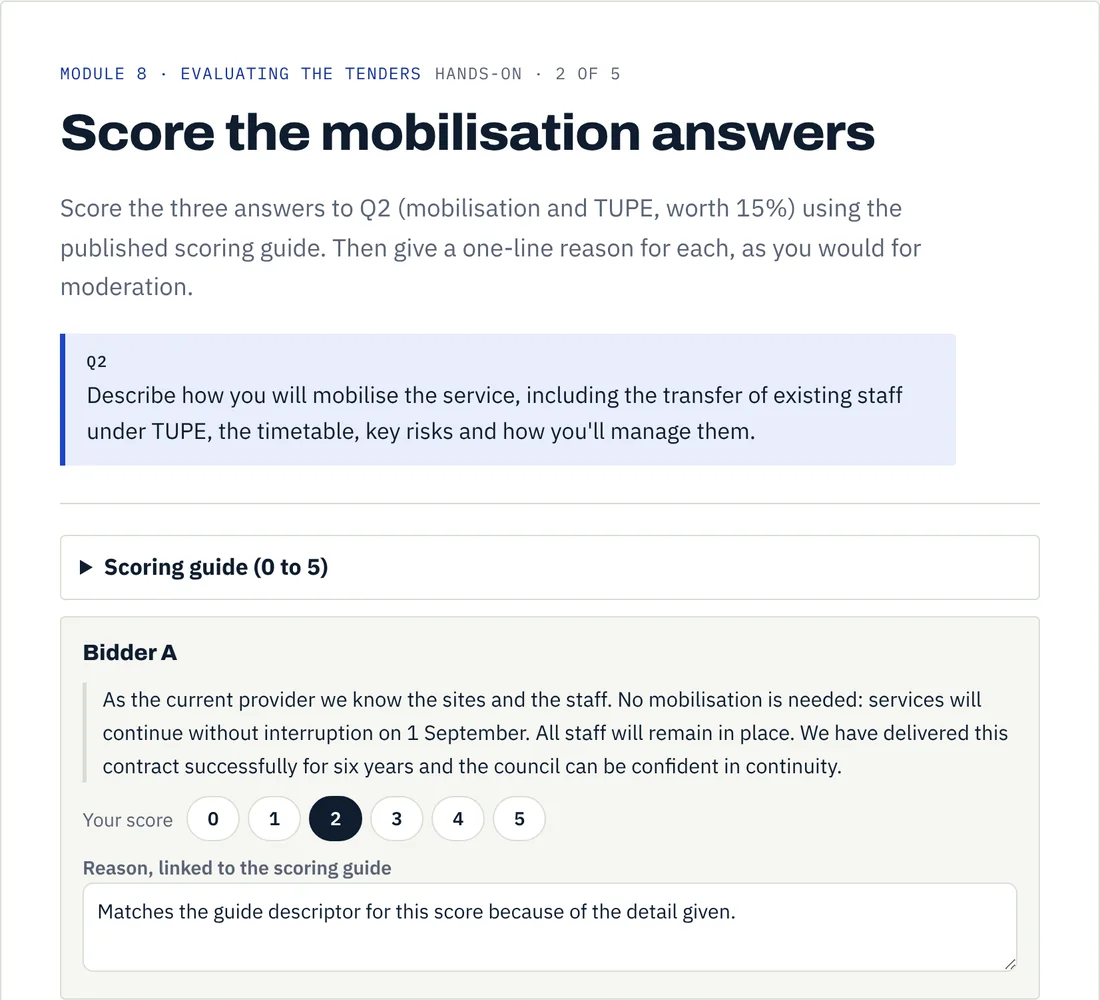
Score real tender answers, then moderate
Three anonymised answers on mobilisation and TUPE. Score each against the published guide, write your reason, then compare with the panel's moderated scores. Then calculate the price scores and see who wins. It isn't the cheapest, and it isn't the incumbent.
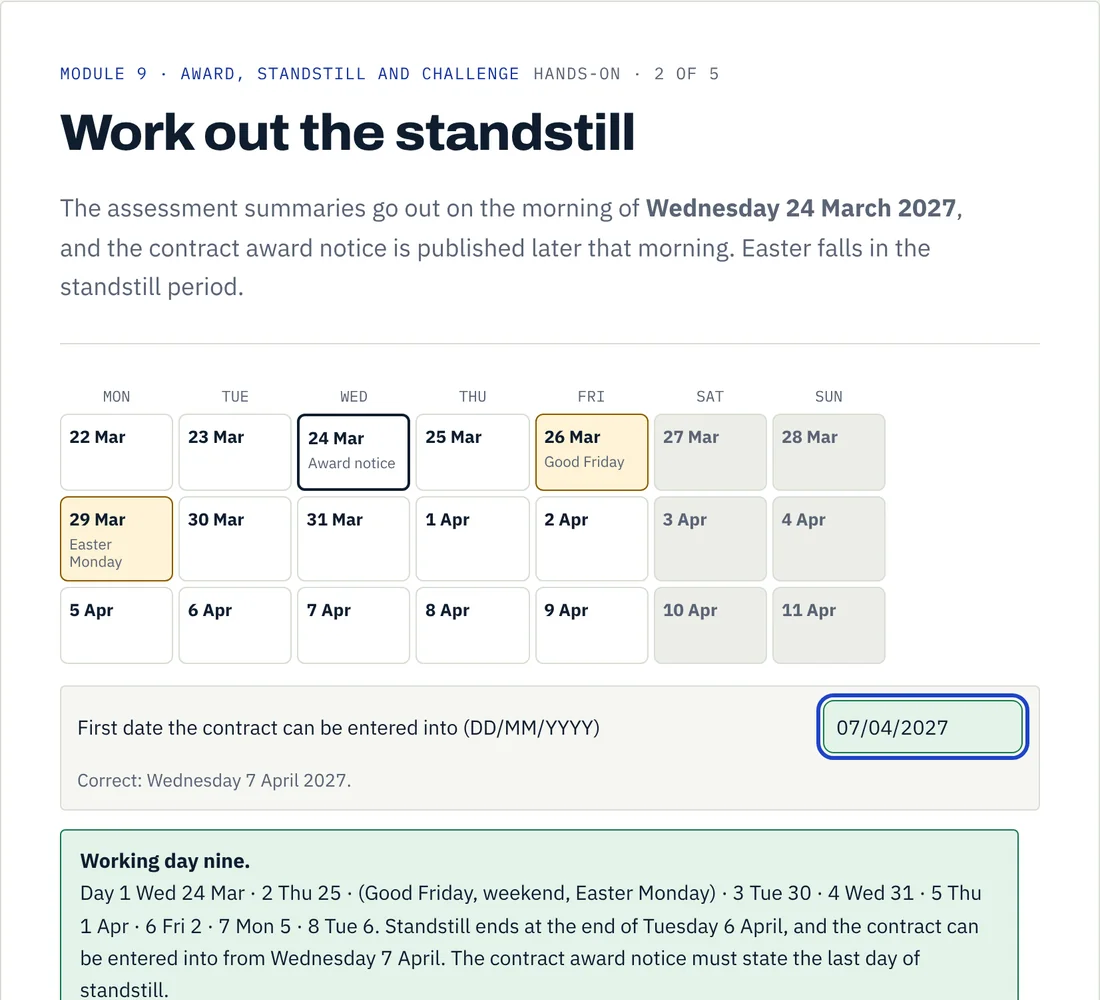
Work out the standstill, with Easter in the way
The contract award notice goes out the week before Easter. When can you sign? Then deal with an angry incumbent and court proceedings issued mid-standstill.
- Assessment summaries and the contract award notice
- Automatic suspension, and what your tender file is for
Course outline
Ten modules, one tender, start to finish
Each module ends with a short test where every answer is explained. You need 80% to move on and can retake as often as you like. Progress saves in your browser.
- 01
Welcome to the public sector
Why the rules exist, the vocabulary, and Dave's first request: "just extend it".
- 02
The rules of the game
The Procurement Act 2023, its objectives, thresholds, valuing a contract, and the notices.
- 03
Before you go to market
The need, the specification, fair market engagement, conflicts of interest and lots.
- 04
Choosing your route
Open, competitive flexible, frameworks and direct award, plus realistic timescales.
- 05
Who can bid
Proportionate conditions of participation, exclusions and the debarment list.
- 06
Designing the award criteria
The most advantageous tender, weightings, social value and the scoring guide.
- 07
The tender is live
Clarifications, a mistake in your documents, a late bid and an abnormally low price.
- 08
Evaluating the tenders
Score real answers, moderate, calculate price scores and resist pressure to change them.
- 09
Award, standstill and challenge
Assessment summaries, standstill, an angry incumbent and automatic suspension.
- 10
Contract, changes and certificate
Contract notices, KPIs, prompt payment, a contract change, your tender file and the final assessment.
Your certificate
A certificate to share with your network
Founder, Young Procurementprocurementskillstraining.com
Complete every module and pass the final assessment to receive a certificate of completion with your name and final score. Save it as a PDF.
Then share it: we'll give you a ready-written LinkedIn post, a one-click share and an "Add to profile" button for your Licences & certifications.
A certificate of completion for independent training. It isn't a formal qualification and isn't endorsed by CIPS.
What you get
A public tender, run start to finish, in an afternoon
- 0110 interactive modulesShort lessons built around one realistic contract, about 3 to 4 hours in total.
- 0216 decisions with consequencesPressure from colleagues, councillors and suppliers, with feedback on every option and a tender file review at the end.
- 03Hands-on workValue the contract, build the award criteria, score tender answers, calculate price scores and work out standstill.
- 04Tests that teachA short test after every module and a final assessment, with every answer explained.
- 05A certificate to shareDownload it as a PDF and share it on LinkedIn in a couple of clicks.
Good to know
- Covers the Procurement Act 2023 as it applies in England, with thresholds from 1 January 2026. Wales, Scotland and Northern Ireland have some differences.
- It's training, not legal advice.
- Your name and progress stay in your browser. Use the same device and browser to pick up where you left off.
Questions
Before you buy
Do I need any legal or public sector background?
No. It's written for people from outside the public sector. Everything is explained in plain English as you go, through one realistic contract.
I'm a supplier. Is it useful for bidding?
Very. You design the award criteria, score real answers against a scoring guide and see why a strong-looking incumbent loses. That's exactly how your bids are judged.
Is it up to date?
It covers the Procurement Act 2023, which has applied since 24 February 2025, with the thresholds that apply from 1 January 2026 and current guidance on notices, standstill and social value. Content was last reviewed in November 2026.
Does it cover Wales, Scotland or Northern Ireland?
It's written for England. Wales and Northern Ireland use the Act with some differences, and Scotland has its own regime. The principles carry across, but check local rules.
Is this a CIPS qualification?
No. It's independent training with its own certificate of completion. For CIPS qualifications, see Procurement Training.
Is it really free?
Yes. No sign-up, no payment and no email needed. It's our way of showing what our training is like. If you enjoy it, take a look at our other courses and tools at the end.
Can my team use it?
Yes. Send them the link: each person takes it in their own browser and gets their own certificate. For live team training, email Tim.
Where is my progress saved?
In your own browser, on your device. Nothing is sent to us. If you clear your browser data or switch devices, you'll start again.